 (973) 744-0804
 Pay Invoice
Augmentative and alternative Communication
Speech & Language Therapy
Request a Consultation
What is Augmentative and Alternative Communication?
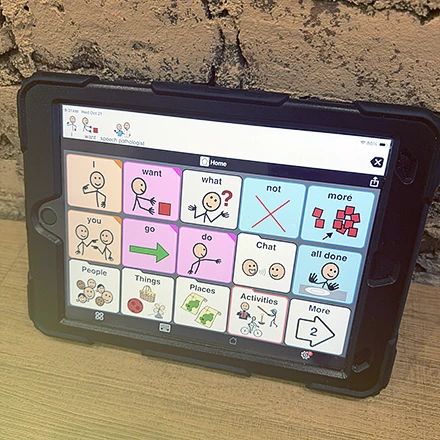
Augmentative and Alternative Communication (AAC) uses a variety of systems to support individuals with varying communication profiles and presentations and support their receptive (e.g., comprehension of vocabulary, routines, social interactions) and expressive language (e.g., wants, needs, medical necessities) skills.
Augmentative adds to an individual’s current communication modalities. Alternative refers to a method used in place of verbal speech.
Systems/Tools for AAC
- No/Low-tech: Gestures, facial expressions, sign language, picture boards,
and communication books that are not speech generated. - Mid-tech: Simple battery-operated devices with pre-recorded words or
purposefully limited messages. - High-tech: Computer tablets, smartphones with special apps, and dedicated
speech-generating devices that produce artificial voices.
How AAC Works in Therapy

Modeling
Therapists demonstrate how to operate the AAC system (e.g., navigating between folders, selecting vocabulary) while simultaneously providing aided language input (ALI) to support language input and output. Therapists also teach caregivers and/or communication partners how to utilize and model with the AAC system, customize vocabulary, and support device use across environments.

Multimodal Approach
A multimodal approach to AAC includes using a variety of communication modalities, including, but not limited to, an AAC system, speech, and gestures to support communication across environments and to support the individual’s needs.

Expanding vocabulary
AAC supports vocabulary development through the use of core vocabulary (words used in everyday language, e.g., more, all done, goodbye) and fringe vocabulary (specific words, e.g., names of familiar people, preferred items, familiar places), as well as supporting grammar and sentence structure.
Specialized Tools & Certifications

Insurances We Accept
In-Network Insurance Carriers*



*we accept all insurances, pending out-of-network coverage